

The Real Cost of Owning a Home Espresso Machine
A $300 espresso machine and a $300 pair of running shoes have something in common: the sticker price is the smallest number you’ll ever pay. The real cost of owning a home espresso machine shows up later, in bags of beans, descaling solution, replacement parts, and the occasional repair bill nobody budgeted for. Most buyers compare machines by the number on the box. Few compare them by what they actually cost to run for three or five years, and that’s where the real decisions should happen.
This matters more than it used to. Machine prices swing hard during sales events, the Breville Barista Express has been seen priced near $500 during fall 2026 promotions against a regular price closer to $690, which changes the math on payback time depending on when you buy. Meanwhile, manufacturers keep leaning into integrated grinder-and-machine designs, like De’Longhi’s La Specialista Arte Evo launch in Japan in October 2026, because shoppers want fewer boxes on the counter. Convenience and long-term cost don’t always point the same direction, and this guide walks through where they diverge.
Key Takeaways
- The real cost of owning a home espresso machine includes the grinder, maintenance supplies, water treatment, and occasional repairs, not just the machine’s sticker price.
- Beans, not equipment, are usually the largest expense over several years of ownership.
- A grinder should be budgeted as part of the initial purchase, not added later as an afterthought.
- All-in-one machines lower upfront cost and complexity but can mean replacing the entire unit if one subsystem fails.
- Routine maintenance and decent water quality are the cheapest ways to avoid expensive repairs down the road.
The Real Cost of Owning a Home Espresso Machine Starts With the Grinder
The price tag on an espresso machine rarely tells the full story, because a machine without a proper grinder cannot make good espresso. Pre-ground coffee goes stale within days and can’t be adjusted to match your machine, your beans, or your taste. Espresso needs fresh coffee ground fine and consistent, and that requires a grinder built for espresso, not a blade grinder or a basic drip-coffee burr grinder.
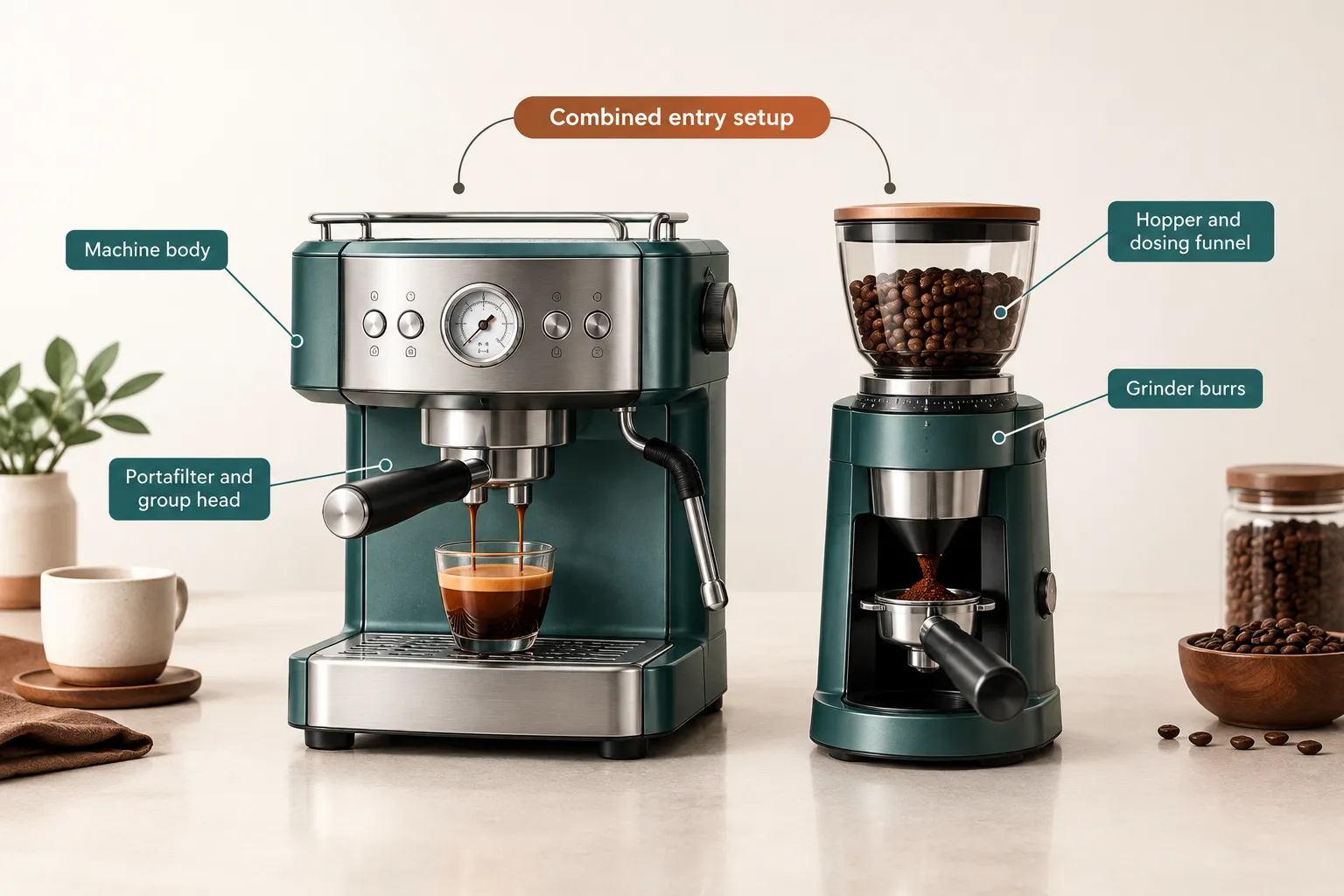
Here’s a simple way to see how this changes the entry price. A Breville Bambino lists around $299.95 on its own, but it includes no grinder at all. Pair it with something like a Baratza Encore ESP, listed around $199.95, and the realistic entry cost for a usable home espresso setup becomes closer to $500, not $300. That’s not a markup or a trick. It’s just the honest starting point for anyone building a practical home espresso setup rather than buying a single box and hoping it’s enough.
This is also why machine and grinder pairing deserves its own line item in your budget, not a mental shortcut. A capable grinder affects grind consistency, which affects extraction, which affects whether your shots taste balanced or swing between sour and bitter. If you’re shopping for a first setup, it’s worth browsing grinders built specifically for espresso before finalizing a machine, since the two should be chosen as a pair rather than in sequence.
Beans Are the Real Cost of Owning a Home Espresso Machine Long-Term
Once the hardware is sorted, the ongoing expense that dwarfs almost everything else is coffee itself. This is the part newcomers consistently underestimate.
Consider someone pulling two double shots a day using an 18-gram dose per shot. That works out to roughly 13.1 kilograms of beans a year. Bump the dose to 20 grams, which is common on many modern baskets, and annual consumption rises to about 14.6 kilograms. Multiply that by the price of decent espresso-roast beans, and it becomes clear why cost-of-ownership analyses keep landing on the same conclusion: beans can exceed the price of the machine itself within one to two years of regular use.
This isn’t a reason to buy cheap, stale, or bulk-bin coffee. Bean freshness and roast level directly affect how easy a shot is to dial in, and stale beans are a common hidden cause of flat, sour, or inconsistent espresso. If your shots keep coming out sharp or sour no matter how you adjust grind size, it’s worth ruling out bean age before blaming the machine, see this breakdown of why espresso turns out sour and what to fix first for a logical troubleshooting path.
The practical takeaway: when budgeting for ownership, treat beans as a recurring monthly expense similar to a subscription, not a one-time grocery item. A household pulling two shots daily should expect bean costs to be the single largest line in their home espresso setup over a three-year span, ahead of the machine, the grinder, and all accessories combined.
Maintenance, Water, and Repairs Nobody Budgets For
Maintenance is the part of espresso machine maintenance that’s easy to skip and expensive to ignore. Minerals in tap water build up inside boilers and valves over time, and that scale buildup is one of the most common root causes behind weak pressure, slow flow, and eventual pump or valve failure.
Based on industry cost estimates, a realistic annual maintenance budget runs somewhere between $105 and $230, covering descaling solution, portafilter cleaner or detergent, water filters, and basic cleaning brushes or cloths. The exact number depends heavily on your local water hardness and how often you pull shots. Owners in hard-water regions should expect to land on the higher end of that range, or invest in a water filtration setup to reduce mineral buildup before it becomes a mechanical problem.
Skipping maintenance doesn’t make the cost disappear, it just moves the bill from “cheap and routine” to “expensive and urgent.” When internal components fail, here’s roughly what repairs tend to cost:
| Repair Type | Estimated Cost Range |
|---|---|
| Pump or solenoid valve repair | $200,$400, including labor |
| Heating element repair | $230,$500 |
| Independent technician labor | $75,$150 per hour |
These numbers make a strong case for prevention. A $15 bottle of descaler used on schedule is a lot cheaper than a $300 pump replacement caused by three years of scale buildup. If you’re not sure where to start, a focused look at maintenance and water quality practices for home machines is one of the highest-value things a new owner can read before problems start.
Repairability also varies a lot by machine design. Baratza, for example, sells individual replacement parts, including burr components, for machines like the Encore ESP, which means a worn part doesn’t require replacing the whole grinder. Machines built around commercial-style, swappable components tend to stay serviceable for many years. That’s a meaningful difference worth weighing against upfront price, not an afterthought.
All-in-One vs. Separates: Convenience Now, Risk Later
Integrated machines that combine a grinder and espresso machine into one unit, including popular models like the Breville Barista Express, solve a real problem: fewer things to shop for, fewer things to plumb together on a counter, and one dial-in workflow instead of two separate learning curves. That convenience is genuine, and for a lot of first-time buyers it’s exactly the right tradeoff.
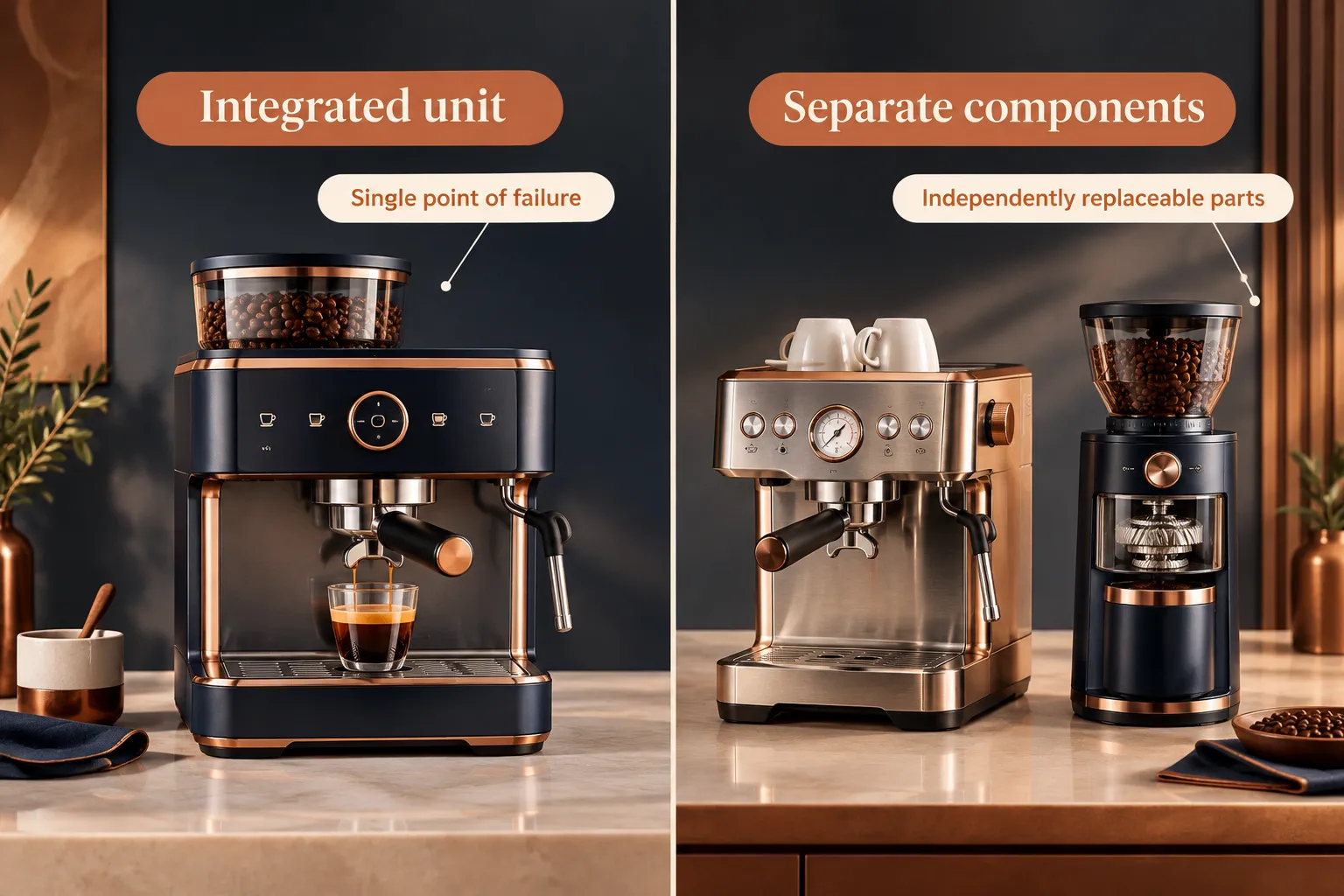
But convenience comes with a long-term catch. In an all-in-one design, the grinder is built into the machine and generally can’t be swapped out or upgraded independently. If the grinder becomes the limiting factor on your shots, too inconsistent at fine grind settings, for example, your only real upgrade path is replacing the entire machine, grinder included. The same logic applies if either subsystem fails outside of warranty: a broken boiler and a broken grinder motor can both mean replacing a working half of the machine just to fix the broken half.
Separate machines and grinders avoid that bundled risk. If the grinder wears out or you simply want a better one, you replace only that piece and keep your espresso machine exactly as it was. If the machine’s pump fails, your grinder is untouched. This is one of the clearer meaningful differences between all-in-one and separates, and it’s worth more attention than most buying guides give it.
Neither approach is objectively better, it depends on your priorities. All-in-one machines are easier to live with for buyers who want one countertop footprint and one simple workflow, and who are comfortable replacing the whole unit eventually. Separates suit buyers who want to upgrade pieces independently over time, or who’ve already decided they want more control over machine and grinder pairing as their technique improves. For a side-by-side look at how specific models stack up on this tradeoff, the reviews and comparisons library covers this in more depth across individual machines.
How Capsules, Bean-to-Cup, and Manual Brewing Compare on Cost
Espresso machines aren’t the only way to get espresso-style coffee at home, and it’s worth understanding how the alternatives stack up financially, even if this site’s main focus stays on semi-automatic machines.
A 2026 European cost analysis estimated that a bean-to-cup automatic machine produces a drink for roughly €0.28 per cup in ingredients, energy, and maintenance combined, compared with about €0.55 per cup for capsule-based machines, nearly double, mostly driven by the premium built into pre-packaged capsules. Neither estimate includes the original machine purchase price, which matters: capsule machines are often cheaper upfront but more expensive per cup over time, while bean-to-cup machines cost more initially but repay that difference through cheaper ingredients.
Manual brewing sits at the opposite end of the complexity spectrum. A moka pot, for instance, has no pump, no boiler, no electronic controls, and nothing to descale beyond an occasional rinse and basic cleaning. That simplicity means there’s almost nothing to repair and no meaningful electricity draw. The tradeoff is real, though: a moka pot can’t generate true espresso pressure, so it won’t produce the same crema or extraction character as a pump-driven espresso machine. It’s a different drink, not a budget version of the same one.
As for electricity itself, cost-of-ownership research consistently finds that power draw is a minor factor for home machines, it only becomes meaningful if a machine is left heated around the clock rather than warmed up before use and turned off afterward. If you’re trying to shrink your real cost of owning a home espresso machine, bean quality, water treatment, and basic maintenance habits matter far more than worrying about standby power.
Choosing the Right Setup for Your Budget
Working through practical buying guidance means matching equipment to how you’ll actually use it, not to a spec sheet. A few honest starting questions help:
- How many shots per day will this machine realistically make? One or two a day changes the math on beans, maintenance frequency, and even which machine size makes sense, compared with a household pulling four or five.
- Do you want to upgrade pieces separately later, or replace the whole setup every several years? This is the core question behind choosing an all-in-one versus separate machine and grinder.
- What’s your water like? Hard water pushes maintenance costs and descaling frequency higher regardless of which machine you choose.
- Are you comfortable learning to dial in your espresso, or do you want fewer variables to manage? Entry-level semi-automatic machines ask more of the user upfront but tend to be more serviceable and more flexible as you improve.
Who this is for: budget-conscious beginners willing to learn a little technique, and anyone who wants a home espresso setup that can grow with their skills rather than being replaced wholesale in three years.
Who should skip it: anyone who wants zero learning curve and doesn’t mind paying more per cup for that convenience, a capsule machine may be the better fit, even though it falls outside this site’s main coverage area.
Before buying anything, it’s worth spending time with a buying guide built around real ownership tradeoffs rather than a spec comparison alone, since the right machine depends on your habits as much as your budget.
Frequently Asked Questions
Is a cheaper espresso machine actually cheaper over three years? Not necessarily. A lower-priced machine with a weak built-in grinder or no serviceable parts can cost more over time if it needs full replacement, while a mid-priced machine with swappable components may stay cheaper to keep running.
Do I really need a dedicated espresso grinder? Yes, for consistent results. Pre-ground coffee goes stale fast and can’t be adjusted for your machine, and a blade grinder produces uneven particles that make it hard to dial in your espresso with any consistency.
How much should I expect to spend on maintenance each year? Industry estimates put typical annual maintenance, descaler, cleaning supplies, filters, around $105 to $230, with hard-water households landing on the higher end.
Are all-in-one machines a bad investment? Not inherently. They reduce upfront cost and complexity, which makes them genuinely easier to live with for many first-time buyers. The tradeoff is that a failed or outgrown grinder often means replacing the whole unit instead of one part.
What’s the single biggest cost most people overlook? Beans. Annual coffee consumption for regular daily use can exceed 13 to 14 kilograms, and that ongoing cost typically surpasses the machine’s price within one to two years.
Can I save money by skipping maintenance? Only in the short term. Scale buildup from skipped descaling is a common cause of pump, valve, and heating element failures, and those repairs cost far more than routine cleaning supplies.
Conclusion
The real cost of owning a home espresso machine isn’t hidden, it’s just spread across categories buyers don’t always think to add up: the grinder, the beans, the descaling routine, and the occasional repair. None of these costs require obsessive tracking or expensive equipment to manage well. They just require an honest budget that includes the grinder as part of the purchase, beans as a recurring expense, and basic maintenance as routine upkeep rather than an afterthought.
If you’re choosing your first setup, start by pairing a machine with a grinder you can actually afford together, not separately. Build a basic maintenance habit from day one rather than waiting for a problem to force it. And if a machine’s price looks unusually low, ask what’s missing, a grinder, serviceable parts, or long-term flexibility, before assuming it’s the better deal. For more on building out common espresso problems, technique, and setup from the ground up, the full blog archive is a practical next stop.
Meta Title: The Real Cost of Owning a Home Espresso Machine (2026 Guide)
Meta Description: The real cost of owning a home espresso machine goes beyond the price tag. See what beans, grinders, maintenance, and repairs actually add up to.
Tags: home espresso machine, espresso machine cost, home espresso setup, espresso grinder, machine and grinder pairing, espresso maintenance, semi-automatic espresso machine, Breville Barista Express, buying guide, espresso troubleshooting, home barista, espresso ownership costs
Contributing writer at Espresso Savvy.
