

How Often Should You Descale Your Espresso Machine?
Most home espresso owners wait until their machine starts sputtering, gurgling, or pulling slow shots before they even think about descaling. By then, mineral scale has already been coating the boiler and internal tubing for months. The honest answer to how often should you descale your espresso machine is: it depends on your water hardness and how much you brew, but a practical range for most home setups is every one to four months.
That range is wide because the variables matter more than a single universal number. A machine running soft water in a low-use household can go much longer between descaling sessions than a machine pulling three or four shots a day on hard tap water. This guide breaks down exactly what drives that difference so you can set a schedule that actually fits your home espresso setup.
Key Takeaways
- There is no single fixed interval. How often should you descale your espresso machine depends mainly on water hardness and brewing volume.
- A common default for home machines without hardness sensors is every 1 to 3 months.
- Harder water requires more frequent descaling; soft water can stretch the interval to 3 to 4 months or longer.
- Using filtered or softened water and following manufacturer guidance reduces descaling frequency and extends machine life.
- Ignoring descaling leads to common espresso problems like slow flow, temperature instability, and reduced boiler lifespan.
What Descaling Actually Does and Why Frequency Varies
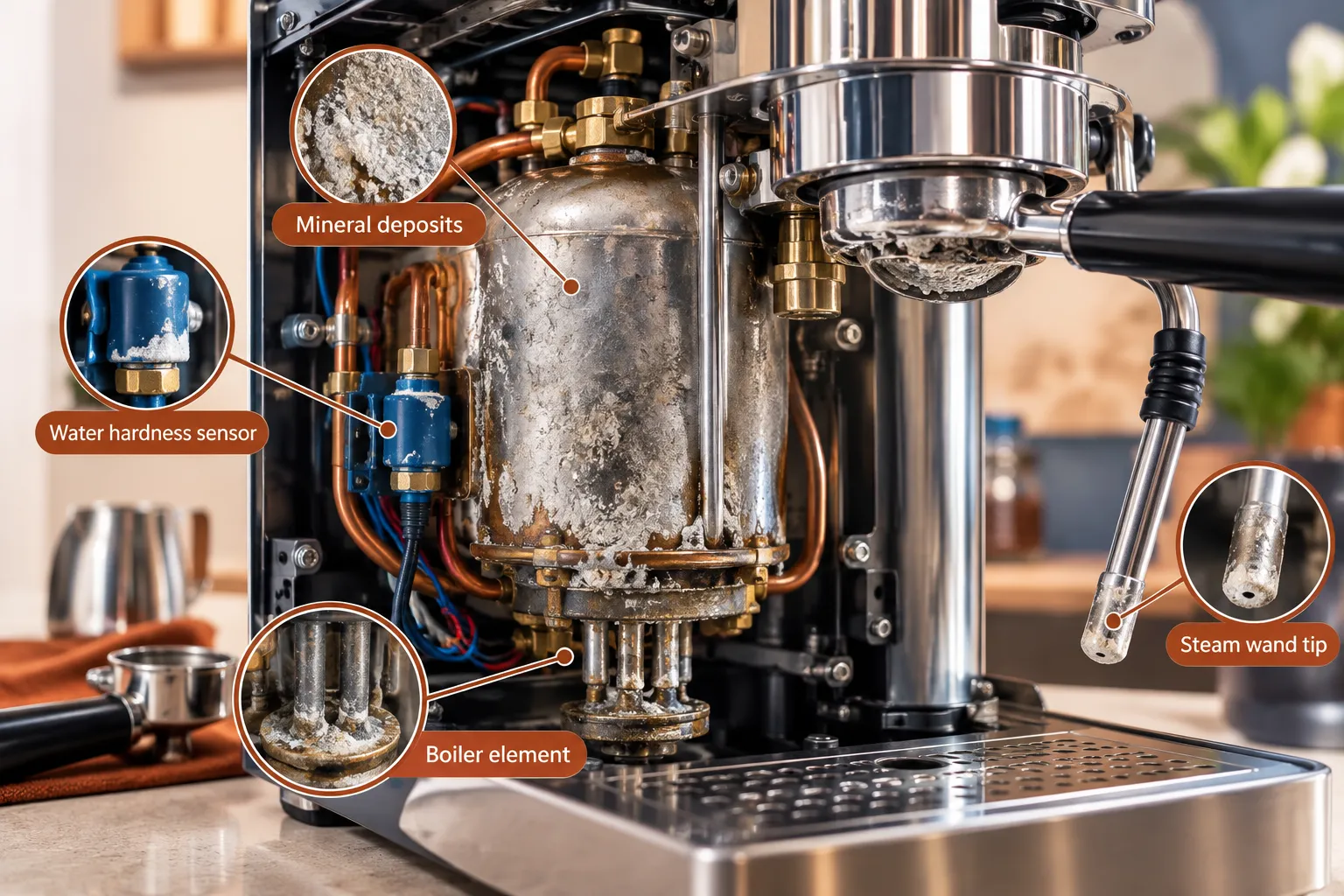
Descaling removes mineral buildup, mainly calcium and magnesium, that forms inside the boiler, heating element, and internal plumbing whenever you heat hard water repeatedly. This buildup is called limescale, and it does not rinse away with normal cleaning. Over time it narrows water pathways, insulates heating elements so they work harder, and can trigger the kind of flow and temperature problems covered in our guide to espresso troubleshooting.
Manufacturers have moved away from giving one fixed number for everyone. De’Longhi, for example, ties its recommendation to water hardness and usage rather than a flat calendar date, and many newer machines let you set a hardness level so the built-in alert adjusts automatically. Breville’s general guidance for home espresso machines is a 1 to 3 month window, adjusted based on how often the machine is used. Philips and Saeco cite an average of about every 3 months, with heavier daily use pushing that closer to monthly.
The common thread across these brands is that water hardness and brewing volume are the two biggest levers. A machine is not on a fixed internal clock. It is reacting to what is actually passing through it.
How Water Hardness Changes the Answer
Water hardness is typically measured in milligrams of calcium carbonate per liter (mg/L). The U.S. Geological Survey classification widely used by water treatment professionals breaks it down like this:
| Hardness Level | Range (mg/L as CaCO3) | Typical Descaling Interval |
|---|---|---|
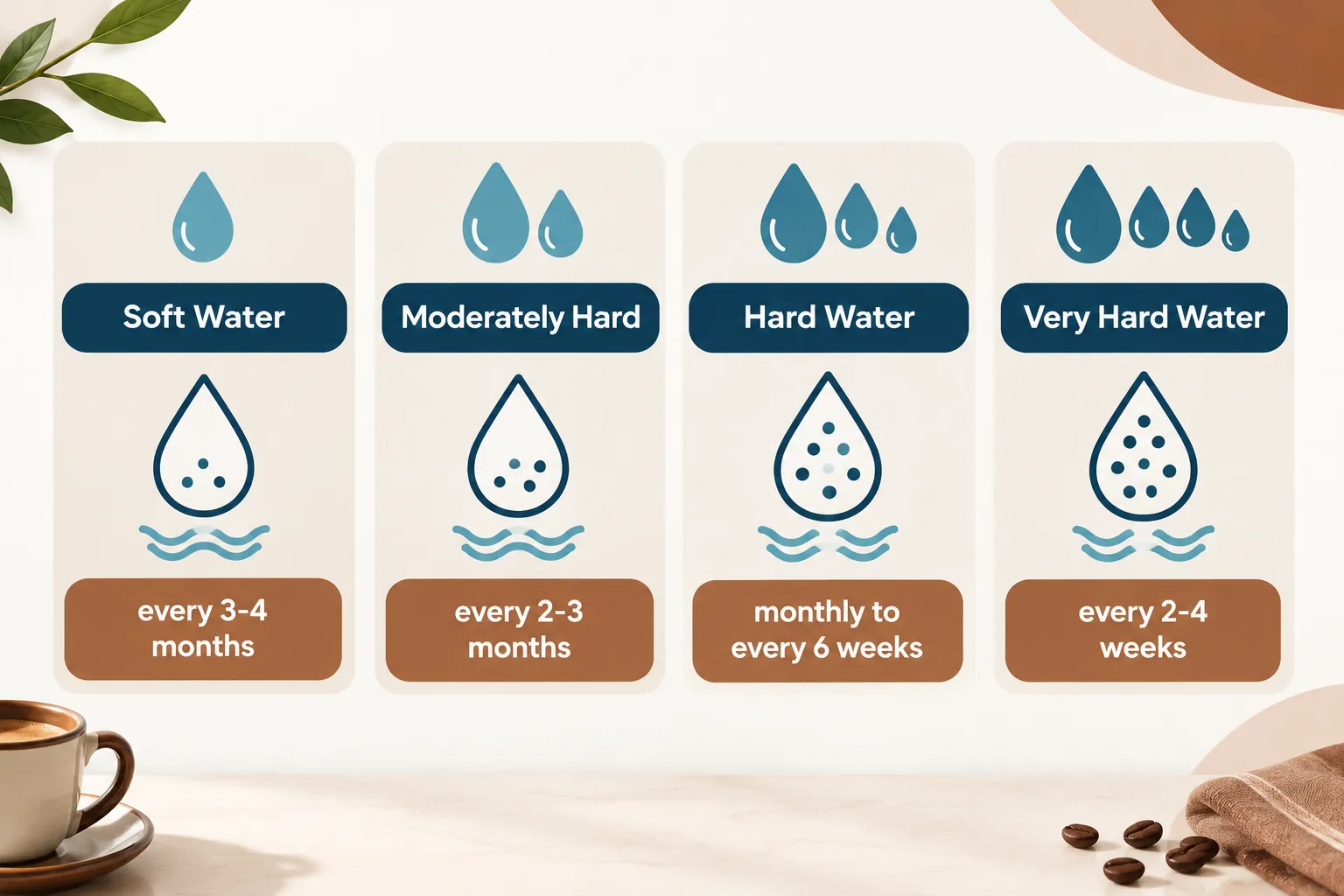
| Soft | 0-60 | Every 3-4 months |
| Moderately hard | 61-120 | Every 2-3 months |
| Hard | 121-180 | Monthly to every 6 weeks |
| Very hard | Above 180 | Every 2-4 weeks |
If you do not know your local water hardness, a simple test strip from a hardware store or filter manufacturer will tell you in about 30 seconds. This single piece of information is more useful than any generic calendar reminder, because it tells you which end of the range applies to your home.
It is worth noting that water chemistry is not just about hardness. The Specialty Coffee Association has pointed out that espresso water needs a balance between scale risk and corrosion risk. Water that is too mineral-free can actually corrode metal components and flatten espresso flavor, while water that is too hard accelerates scale. This is part of why extremely aggressive softening is not automatically better, and why plain distilled water is not recommended for daily use in most machines.
How Often Should You Descale Your Espresso Machine Based on Usage
Water hardness sets the baseline, but daily brewing volume shifts the number up or down within that range. A machine making one or two shots a day accumulates scale much more slowly than one running six or eight shots across a household each morning.
As a practical starting point for a typical home espresso setup without a built-in hardness sensor:
- Light use (1 to 2 shots daily), soft to moderate water: descale every 3 to 4 months
- Moderate use (3 to 5 shots daily), moderate water: descale every 2 months
- Heavy use (6 or more shots daily), or any use with hard water: descale monthly to every 6 weeks
These numbers line up with Nespresso’s general public guidance of roughly every 2 to 4 months, and with a separate Nespresso document that frames the interval around either number of brews or elapsed time, whichever comes first, since both factors independently push scale accumulation.
Machine Type Matters Too
Not every espresso machine handles scale the same way, and this is where choosing the right espresso machine pays off over time, not just at setup.
Machines with built-in hardness sensors or programmable alerts. Higher-end prosumer and some mid-range machines let you input your water hardness and will alert you when descaling is actually due, rather than on a guess. Jura’s approach is a good example: harder water settings shorten the interval automatically, and machines with an active water filter cartridge may not prompt a descale at all because the filter is already removing the minerals that would otherwise build up.
Machines without sensors. Many popular semi-automatic home machines, including entry and mid-tier models in the Breville Bambino and Barista lines, the Gaggia Classic, and the Rancilio Silvia, rely on the owner to track usage manually. For these, the 1 to 3 month default is the safest starting point, adjusted by your water hardness test result.
Prosumer machines with proper water prep. Profitec’s guidance takes a more preventive stance: if you consistently feed the machine correctly softened or treated water, descaling can become a rare event, sometimes unnecessary for years, with professional servicing reserved for visible malfunction rather than a fixed schedule. This underlines a bigger point: the real lever is water quality control, not descaling frequency alone.
Signs You Are Overdue, Even If You Have Lost Track
If you are unsure where you stand, your machine will usually tell you before it fails outright. Watch for:
- Noticeably slower shot flow even with a correct grind size
- Steam pressure that feels weaker or takes longer to build
- Water flow that stutters or the machine struggles to reach brew temperature
- Visible white, chalky residue around the portafilter basket or steam wand tip
- An unusual number of extraction problems that cleaning and dialing in your espresso do not explain
If your shots have gone sour or inconsistent and grind adjustments are not fixing it, scale buildup affecting water temperature is worth ruling out. Our breakdown of why espresso tastes sour covers temperature-related causes in more detail.
A machine that has never been descaled is not quietly fine. It is just failing slowly enough that you have not noticed yet.
A Practical Descaling Routine for Home Use
You do not need a complicated system to stay on top of this. A workable routine looks like:
- Test your tap water hardness once, or check your municipal water report
- Set a recurring reminder based on the table above, adjusted for your actual daily shot count
- Use a descaling solution designed for espresso machines, not generic vinegar, since vinegar can leave residue and is not recommended by most manufacturers
- Follow your machine’s specific descaling cycle in the manual rather than a universal one
- Combine descaling with routine cleaning of the portafilter, group head, and drip tray as part of regular espresso machine maintenance
If you are using a water softening pitcher filter or an inline filter, factor that in. A correctly maintained filter reduces the minerals reaching the boiler, which can meaningfully stretch your descaling interval, sometimes to the 3 to 4 month range even with moderately hard tap water.
Why This Matters for Real-World Ownership
Skipping descaling does not just risk a bad shot. It shortens the practical lifespan of the heating element and can lead to costly repairs or early replacement, which matters a lot when you are thinking about the real cost of owning a home espresso machine. A five-minute descaling cycle every month or two is far cheaper than a boiler repair or a machine that needs replacing years earlier than it should.
This is also a case where a small amount of planning makes the whole hobby easier to live with. You do not need to obsess over it weekly. You need one accurate data point about your water and a reminder that matches it.
FAQ
Can I use vinegar instead of a commercial descaling solution? Most manufacturers advise against it. Vinegar can damage rubber seals over repeated use and may leave a lingering smell or taste. A citric-acid-based descaling solution made for espresso machines is the safer, manufacturer-recommended choice.
Does using bottled water mean I never need to descale? No. Many bottled waters still contain enough minerals to cause scale over time, and some are even harder than tap water. Check the mineral content on the label, or use a filter designed specifically for espresso machines.
Is distilled water a good way to avoid descaling? Not generally. Water with almost no minerals can corrode internal metal components and flatten the taste of your espresso. Filtered or softened water that keeps hardness within a controlled range is a better long-term choice.
How do I know if my machine has a built-in descaling alert? Check your owner’s manual or the machine’s settings menu. Models with programmable hardness settings, common in higher-end Jura, De’Longhi, and some Breville models, will prompt you automatically once you input your water hardness level.
Will descaling fix slow or uneven shots on its own? Sometimes, but not always. If flow problems persist after descaling, check your grind size and dose first. Our step-by-step dialing in guide walks through the most common adjustments.
Do grinders need descaling too? No, descaling applies to water-heating components, not grinders. Grinders need regular cleaning for coffee oils and retained grounds instead. See our grinder resources for grind-specific maintenance.
Conclusion
There is no single correct answer to how often should you descale your espresso machine that applies to every household. What matters is testing your water hardness, being honest about your daily shot count, and matching your schedule to those two facts rather than a vague rule of thumb. For most home espresso setups without a built-in hardness sensor, every 1 to 3 months is a sound starting point, moving toward monthly if your water is hard or your household brews heavily.
Next steps: test your water hardness this week, set a recurring reminder based on the table in this guide, and pair it with routine cleaning so your machine stays easier to live with for years rather than months. For more on building out a reliable setup, browse our maintenance and water category or explore espresso machine buying guidance if you are still deciding which machine fits your routine.
Meta Title: How Often Should You Descale Your Espresso Machine?
Meta Description: Learn how often should you descale your espresso machine based on water hardness, usage, and machine type, with a practical schedule you can actually follow.
espresso machine maintenance, descaling schedule, water hardness, limescale removal, home espresso setup, espresso machine care, boiler maintenance, machine and grinder pairing, espresso troubleshooting, water filtration, semi-automatic espresso machines, home barista tips
Contributing writer at Espresso Savvy.
