

Espresso Savvy publishes practical, research-based guidance for home espresso owners, with clear distinctions between research-based assessments and hands-on testing.
A shot that tastes sharp, tangy, or like sucking on a lemon rind is not a flaw in your palate. It is a measurable, physical event happening inside the puck of coffee grounds sitting in your portafilter. New research published in August 2026 even shows that the puck itself behaves like a living, dissolving sponge that changes shape as water pushes through it, which helps explain why sour shots are so common and so fixable. This guide on why is my espresso sour walks through a troubleshooting guide for under-extraction that you can apply the next time you pull a shot, starting with the most likely causes and working down to the less common ones.
Sour espresso almost always means under-extraction: water moved through the grounds too fast, or the coffee didn’t get enough contact time and turbulence to release its full range of flavor compounds. The acidic, sharp-tasting compounds dissolve first. If the shot stops before sweetness and body catch up, sourness dominates the cup. The good news is that this is one of the most correctable problems in practical home espresso, no new machine required.
Key Takeaways
- Sour espresso is a sign of under-extraction, meaning too little of the coffee’s soluble material dissolved into the water before the shot ended.
- Grind size that’s too coarse is the single most common cause, followed by low dose, uneven distribution, and water that’s too cool.
- A useful reference range is 18-22% extraction yield, but treat it as a guideline, not a rule carved in stone.
- New 2026 research shows pressure alone does not reliably fix sour shots, grind consistency, dose, and puck integrity matter more.
- Fixing sour espresso is usually a matter of small, one-variable-at-a-time adjustments, not new equipment.
What Sour Espresso Actually Tells You
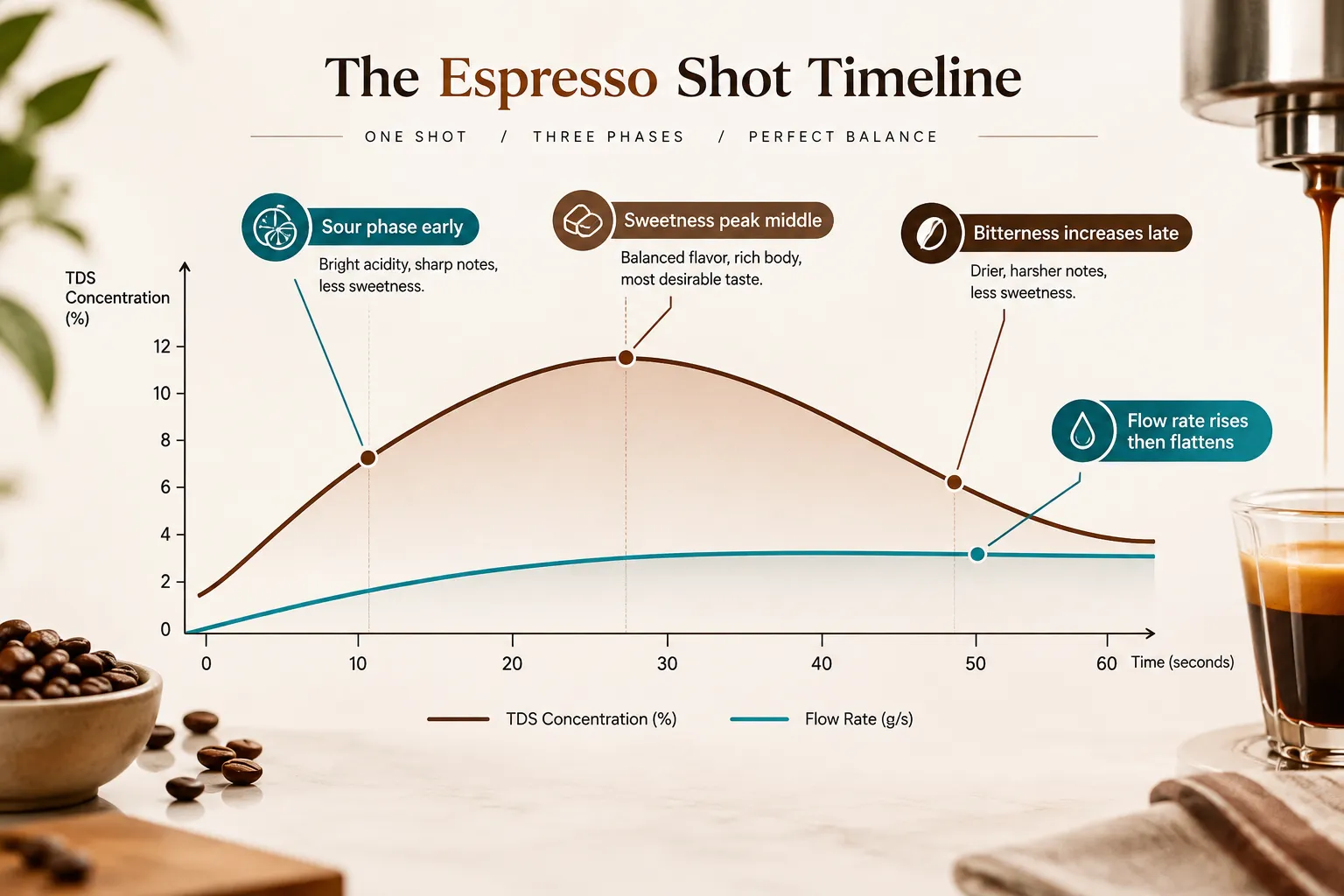
Espresso extraction is the process of dissolving flavor compounds out of ground coffee using hot, pressurized water. Not everything in the grounds is equally easy to dissolve. Acids come out fastest, followed by sugars, and finally the bitter compounds that build up later in the shot. Research on the timing of extraction, including work by Kevin Moroney and colleagues, shows that acidic and sour flavors dominate the early seconds of a pour, sweetness becomes more noticeable in the middle, and bitterness increases toward the end. When a shot is cut short, or when water races through loosely packed grounds, you’re left with a cup weighted heavily toward that early sour character.
A commonly cited benchmark is an extraction yield of 18-22%, with shots below about 18% often tasting sour or thin. It’s worth being honest about where that number comes from: it originated largely in filter-coffee research and gets used for espresso as a practical reference point, not a scientific law. Espresso is far more concentrated than drip coffee, so total dissolved solids (TDS) and extraction yield are measuring two different things. TDS tells you how strong the shot tastes. Extraction yield tells you what percentage of the original coffee mass actually dissolved. A shot can be strong-tasting and still under-extracted and sour, this is a common point of confusion for people newer to dialing in their espresso.
The August 2026 study led by Radost Waszkiewicz and colleagues adds an important nuance here. Time-resolved sampling of shots every five seconds found that TDS peaked around 25.6% in the very first fraction of espresso, then fell rapidly, approaching zero by about 60 seconds. Solute flow, how fast flavor compounds are actually leaving the puck, peaked around 30 seconds into the shot. If your shot finishes well before that window, or if the flow is uneven because of channeling, you’re capturing a disproportionate share of early, sour-leaning extraction and missing the sweetness and body that would normally balance it.
Why Is My Espresso Sour? A Troubleshooting Guide for Under-Extraction Starting With Grind Size
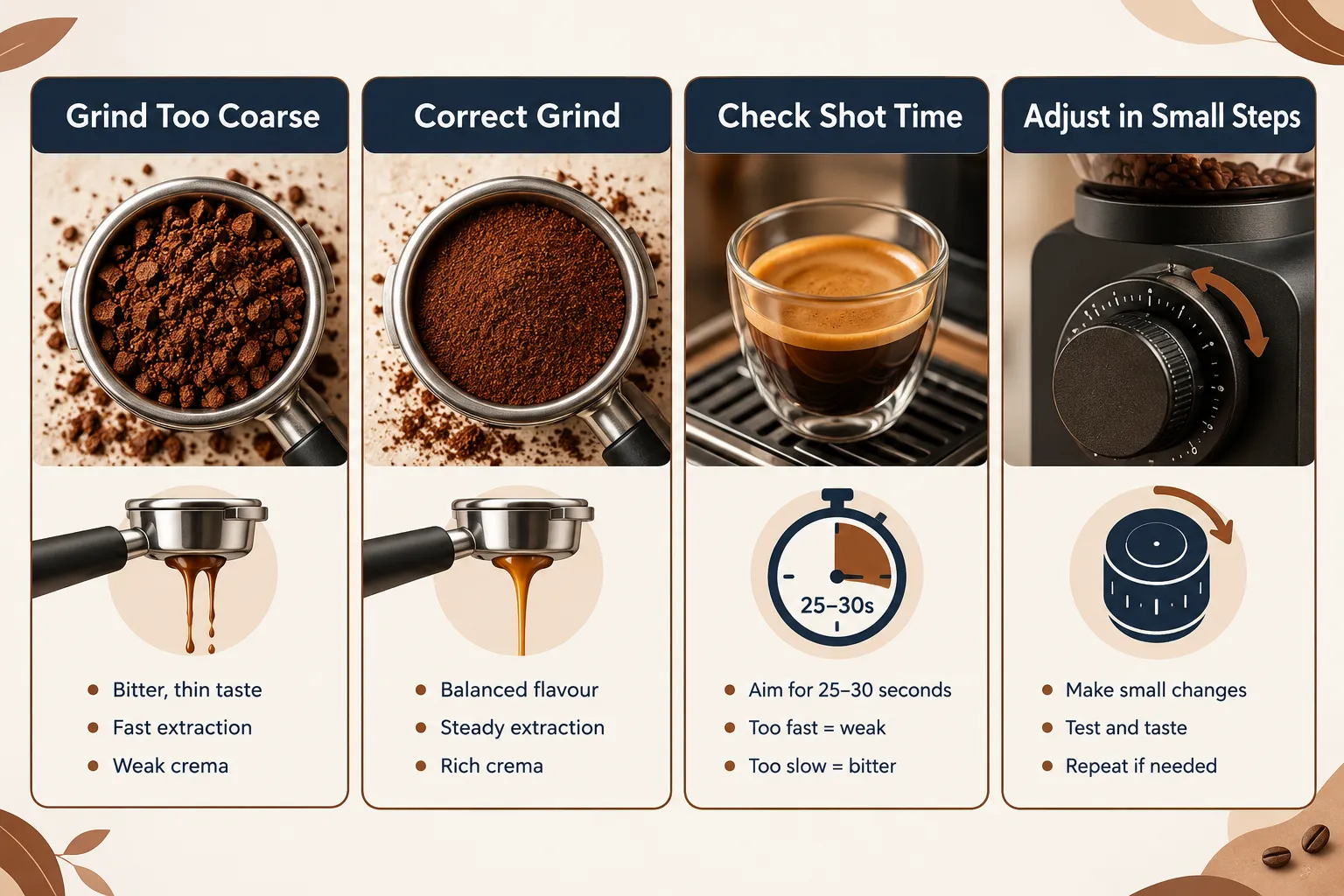
If there’s one place to start, it’s the grinder. Grind size controls how much surface area the water has to work with and how much resistance the puck offers. Coarse grounds create wide channels for water to rush through, so the shot finishes fast without pulling enough flavor out of the coffee. This is the number one reason home shots taste sour.
Quick checks:
- Does your double shot finish in under 20 seconds? That’s a strong sign the grind is too coarse.
- Does the stream look thin and drip quickly rather than flowing steadily, like warm honey?
- Is the crema pale and thin, and does it disappear within a minute?
What to try:
- Grind noticeably finer, a small adjustment on many grinders is a big change in resistance, so move in small increments and taste after each one.
- Aim for a shot time in the 25-30 second range as a starting point, recognizing this varies by machine, dose, and recipe.
- Keep everything else the same while you adjust grind, so you know what actually changed the result.
This is also where machine and grinder pairing matters. A grinder that produces inconsistent particle sizes will never let you dial in reliably, no matter how carefully you adjust the dial. If you’re shopping for new equipment, our buying guides cover how to think about grinder quality relative to your machine and budget.
Check Your Dose, Distribution, and Tamp
Grind size gets most of the attention, but the amount of coffee in the basket and how evenly it’s spread matters just as much. A low dose means less resistance and less material for water to extract from, both push a shot toward sourness. Uneven distribution creates soft spots where water finds the path of least resistance, channeling through before it can properly saturate the rest of the puck.
Common dosing and distribution mistakes:
- Filling the basket by eye instead of weighing the dose on a scale
- Tamping unevenly, with more pressure on one side than the other
- Skipping a distribution step (tapping, stirring, or using a distribution tool) before tamping
- Using a basket size that doesn’t match the dose you’re using
A reasonable starting point for most standard double baskets is somewhere in the 18-20 gram range, though your machine’s basket specification is the better guide than any generic number. Weigh your dose consistently, distribute the grounds so the bed is level, and tamp with even, level pressure. None of this requires expensive gear, a basic scale and a level tamp go a long way in practical home espresso.
Water Temperature and Pressure: What Really Matters
It’s tempting to assume that turning up the pressure on your machine will force more flavor out of the grounds and fix a sour shot. The 2026 puck-physics research complicates that assumption. Waszkiewicz and colleagues brewed 60 coffees across 11 different pressure levels and found that below about 5 bar, flow through the puck behaved in a fairly predictable, proportional way. But at the pressures espresso machines typically use, increasing pressure further caused flow to level off rather than keep climbing. In other words, cranking pressure past a certain point does not reliably pull more flavor out, it just pushes water through faster, which can make sourness worse, not better.
Water temperature is a more dependable lever. Coffee extracts more efficiently at higher temperatures within espresso’s typical range, roughly 195-205°F (90-96°C). If your machine runs cool, some entry-level models do, especially early in a session before they’ve fully stabilized, you may be locking in a sour result no matter how well you grind and dose. Check your machine’s temperature settings if it has them, and give the machine adequate warm-up time before pulling a shot. Consistent water quality also plays a role in maintaining stable extraction over time; our maintenance and water guidance covers why mineral content and descaling routines affect shot quality.
Bean Age, Roast Level, and Freshness
Coffee that’s too fresh or too stale both create extraction problems, though they show up differently. Beans used within a day or two of roasting release a lot of carbon dioxide during brewing. That gas can disrupt water flow and contact time, sometimes producing shots that taste both sour and oddly aerated or inconsistent, shot to shot.
On the other end, beans that are weeks or months past their roast date lose the volatile compounds that carry sweetness and complexity. What’s left extracts unevenly, and the flavor that remains can skew sharp and flat at the same time.
Practical guidance on beans:
- Rest fresh-roasted beans for roughly 5-10 days before using them for espresso, adjusting based on how your specific coffee behaves.
- Store beans in an airtight container away from light and heat, not in the freezer for daily use.
- Buy in amounts you’ll use within 3-4 weeks of the roast date.
- Lighter roasts generally need a finer grind and sometimes a longer shot time to develop sweetness; if you switched to a lighter roast and suddenly got sour shots, your dial-in needs to catch up with the bean, not the other way around.
Machine and Grinder Pairing Issues
Sometimes the sourness isn’t really about technique, it’s about whether your equipment can hit the range you’re aiming for. A grinder with limited adjustment range, especially cheap blade grinders or basic burr grinders designed for drip coffee, may not be able to grind fine enough or consistently enough for espresso. If you’ve made every adjustment above and shots still run fast and sour, the grinder itself may be the ceiling.
Similarly, some machines have limited or no ability to adjust brew temperature, or they lose temperature stability during back-to-back shots. That’s a real ownership consideration, not a personal failure on your part. It’s worth being candid here: not every combination of machine and grinder is capable of consistently avoiding sourness, and recognizing that early saves a lot of frustrated troubleshooting. Our espresso machines and grinders sections walk through what separates capable entry-level gear from equipment that will fight you no matter how carefully you dial in.
Higher-end systems are increasingly trying to solve this pairing problem with automation. In May 2026, Sanremo introduced its single-group D8 One alongside a wired system called Sanremo Link, which connects the machine, grinder, and an optional scale so the system can read extraction data and nudge the grinder toward a target automatically. Mahlkönig Home followed in September 2026 with its first espresso machine, the Xenia Brew-by-Sync, which pairs brewing and grinding in one connected system. These systems are worth knowing about if you’re weighing whether an upgrade is worth it, but it’s worth being clear-eyed: automation can reduce guesswork, but it cannot fix a stale bean, an underfilled basket, or a puck with a crack running through it. The fundamentals in this guide still apply even on the most advanced machine on the market.
A Step-by-Step Troubleshooting Checklist
When a shot tastes sour, work through these checks in order rather than changing several things at once. Changing multiple variables together makes it impossible to know what actually fixed, or worsened, the problem.
- Check shot time. Under 20 seconds for a double shot points strongly to grind size.
- Grind finer in small increments and re-taste before making another change.
- Weigh your dose. Confirm you’re using enough coffee for your basket size.
- Check distribution and tamp. Look for an even, level puck surface.
- Confirm water temperature is in the espresso-appropriate range and the machine has fully warmed up.
- Check bean freshness. Rule out beans that are either too fresh or too old.
- Watch for channeling. A shot that starts fast, sprays unevenly, or has spurts and gaps in the stream often means water is finding weak spots in the puck rather than moving through it evenly.
- Reassess your grinder’s range if you’ve addressed everything above and sourness persists.
This is also a case where restarting a stalled shot can backfire. The 2026 puck-physics study observed that coffee beds swell, crack, and can delaminate during brewing, and that repeated pressure cycles increase flow without adding more dissolved flavor, which suggests that stopping and restarting a shot promotes channeling rather than fixing it. If a shot goes wrong, it’s usually better to discard it and start fresh with an adjustment than to try to rescue it mid-pour.
For a broader library of shot problems beyond sourness, including bitterness, weak crema, and inconsistent shots, the troubleshooting section covers related issues, and the dialing in and technique category walks through the process of finding your recipe from scratch.
When to Consider an Upgrade
Most sour espresso problems are fixable with the checklist above, and it’s worth working through it fully before assuming you need new gear. That said, there are real situations where an upgrade is worth it:
- Your grinder can’t produce a fine, consistent grind suited to espresso, no matter how you adjust it.
- Your machine can’t hold a stable brew temperature across consecutive shots.
- You’ve outgrown a machine designed primarily for convenience rather than adjustment and consistency.
If you’re at that point, our reviews and comparisons coverage and accessories and setup guidance can help you figure out what upgrade actually addresses your specific problem rather than adding complexity you don’t need. An upgrade should solve a defined limitation, not serve as a hopeful fix for a problem that’s really about technique.
Frequently Asked Questions
Is sour espresso the same as weak espresso? Not necessarily. Strength (TDS) and extraction are different measurements. A shot can taste strong and still be under-extracted and sour, especially if it’s a short, fast-flowing shot using a lot of coffee.
Can I fix sour espresso by using more coffee instead of grinding finer? Adding dose helps somewhat, but if the grind is too coarse, more coffee alone won’t solve channeling or fast flow. Grind size and dose usually need to move together.
Does higher pressure fix sour shots? Generally no. Research from 2026 found that flow through the coffee puck saturates rather than rising proportionally once you’re in typical espresso pressure ranges. Grind, dose, and puck evenness matter more than pushing pressure higher.
How long should an espresso shot take to pull? There’s no single universal number, but 25-30 seconds for a standard double shot is a reasonable starting point for most home setups. Treat it as a guide to adjust from, not a strict rule.
My espresso is sour even though the shot time looks right. What else could it be? Check for channeling (uneven spurts in the stream), stale or too-fresh beans, low water temperature, or an uneven tamp. Any of these can produce sourness even at a normal-looking shot time.
Will a new espresso machine fix sour shots? Sometimes, but not always. If your current grinder can’t produce a consistent, fine-enough grind, no machine will compensate. Diagnose the actual limitation first before spending on new equipment.
Conclusion
Sour espresso is frustrating, but it’s also one of the clearest signals your setup gives you. It almost always points back to under-extraction, grind too coarse, dose too low, uneven distribution, water too cool, or beans that aren’t in their best window. Work through the checklist in order: grind size first, then dose and distribution, then temperature and bean freshness, and only then consider whether your machine and grinder pairing is holding you back. Small, one-variable-at-a-time adjustments, tasted honestly, will get you further than any single piece of new gear. For more on getting better espresso at home, explore the full troubleshooting library or browse the Espresso Savvy homepage for practical, no-pressure guidance on building a home espresso setup that actually works for how you drink coffee.
Meta Title: Why Is My Espresso Sour? Under-Extraction Troubleshooting Guide
Meta Description: Espresso tastes sour? Learn the real causes of under-extraction and step-by-step fixes for grind, dose, temperature, and technique problems.
espresso troubleshooting, sour espresso, under-extraction, espresso extraction yield, dialing in espresso, grind size adjustment, espresso machine maintenance, home espresso setup, espresso brewing science, coffee grinder pairing, TDS espresso, espresso technique
Espresso Savvy publishes practical, research-based guidance for home espresso owners, with clear distinctions between research-based assessments and hands-on testing.
