

Hard Water and Espresso Machines: How Mineral Content Affects Your Equipment
A single espresso machine boiler can go from clean to crusted with scale in under a year if your tap water is hard enough, and most owners never check their water until the machine starts acting up. That’s the quiet reality behind hard water and espresso machines: how mineral content affects your equipment is less about taste drama and more about slow, preventable mechanical wear.
If you’ve noticed slower shot times, a machine that takes longer to heat up, or a shot that tastes flatter than it used to, water chemistry is one of the first places to look. This guide breaks down what hardness actually means, how it damages equipment over time, and what you can realistically do about it without turning water chemistry into a hobby of its own.
Key Takeaways
- Hard water and espresso machines don’t mix well over time, mineral buildup narrows pipes, coats heating elements, and can slow or block brewing flow.
- Hardness and alkalinity are different things. Hardness mainly threatens your equipment; alkalinity has a bigger effect on how your espresso actually tastes.
- Manufacturer targets vary. Breville and La Marzocco both publish water guidance, but La Marzocco’s range (roughly 70-100 ppm hardness) is stricter than general coffee-industry standards.
- Very soft or distilled water isn’t automatically the safer choice, it can cause corrosion and interfere with water-level sensors in some machines.
- Regular descaling and water testing are cheaper and easier to live with than repairing a scaled-up boiler down the road.
Why Hard Water and Espresso Machines Are a Long-Term Maintenance Issue
Hard water means water with a higher concentration of dissolved calcium and magnesium. These minerals aren’t dangerous to drink, but inside an espresso machine they behave differently. Every time water heats up in the boiler, some of that dissolved calcium and magnesium can come out of solution and stick to hot metal surfaces as scale, the chalky white crust you’ve probably seen on an old kettle.
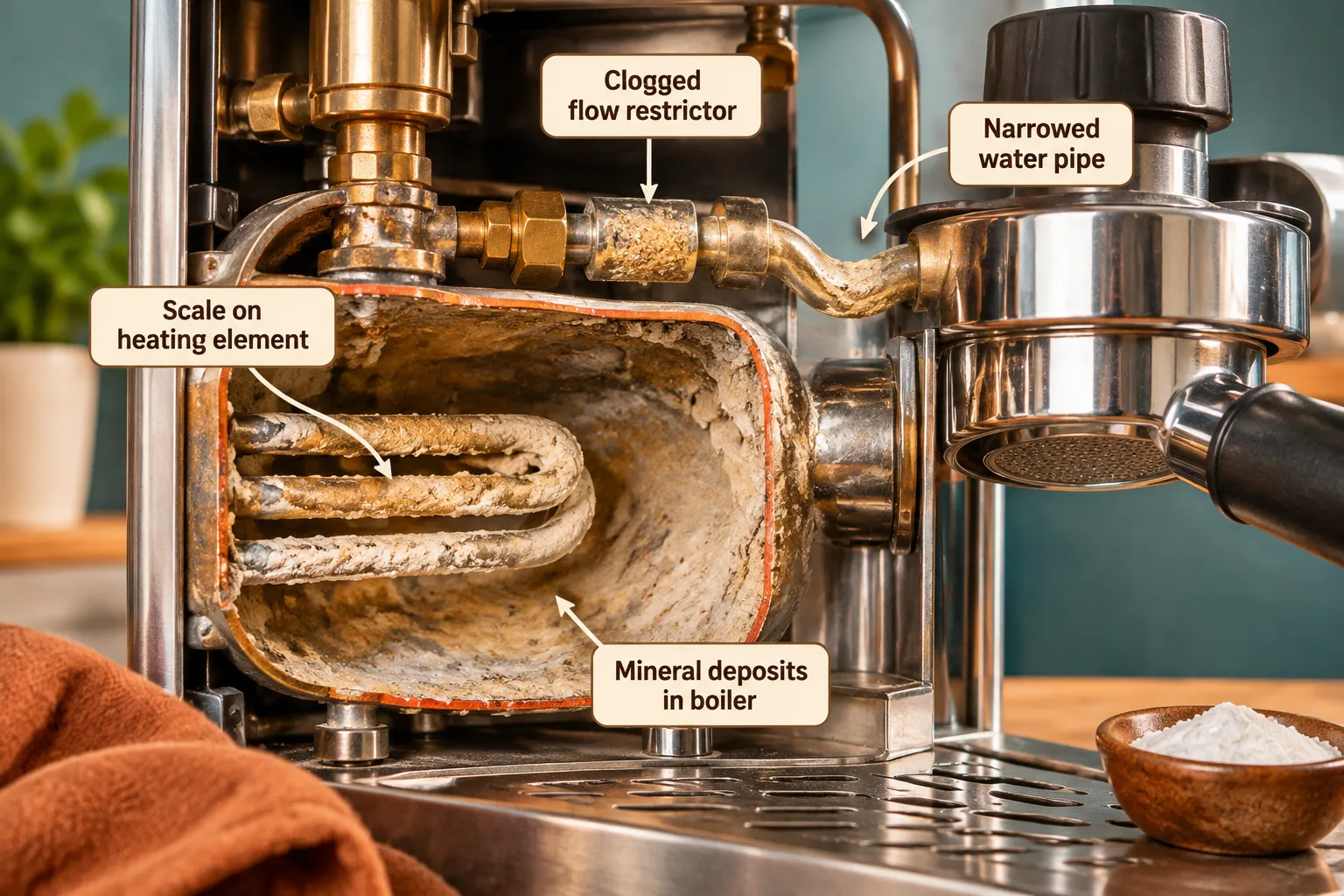
Breville updated its own water guidance in late 2026, stating plainly that hard water can cause mineral buildup that affects brewing flow, temperature stability, overall machine performance, and even the taste of your espresso. That’s a notable shift from treating water as an afterthought to treating it as a core maintenance topic, right alongside espresso machine maintenance basics like backflushing and group head cleaning.
Scale doesn’t just sit harmlessly inside the machine. It builds up on:
- Heating elements, where it insulates the metal and forces the machine to work harder to reach brew temperature
- Flow restrictors and solenoid valves, where even a thin coating can change water flow and pressure
- Boiler walls and pipes, where it gradually narrows the internal diameter
Over months or years, this is how a machine that once hit temperature in a few minutes starts taking noticeably longer, or how shots that used to pull in 25-30 seconds start crawling toward 45 seconds for no apparent reason related to grind or dose.
Hardness vs. Alkalinity: Two Different Problems
This is the part that trips up a lot of home baristas, and it’s worth slowing down on. Hardness and alkalinity are not the same measurement, even though people often use “hard water” loosely to describe both.
- Hardness mostly reflects calcium and magnesium content. It’s the main driver of scale formation inside your machine.
- Alkalinity reflects bicarbonate content, which acts as a buffering agent against acidity in your cup.
Industry guidance updated in November 2026 increasingly treats these as separate variables with separate consequences. Hardness is framed mainly as a scale and equipment-risk factor. Alkalinity, on the other hand, is pointed to as the bigger driver of flavor changes, specifically acidity suppression, bitterness, and a flatter-tasting shot.
A September 2026 peer-reviewed sensory study backs this up in a way that challenges a common assumption. Researchers varied calcium and magnesium levels, even pushing them above what you’d typically find in tap water, and testers couldn’t reliably detect a flavor difference. Bicarbonate, though, had a clear and consistent sensory effect. At levels around 300 mg/L, bicarbonate reduced acidity, fruitiness, and complexity in the cup while increasing roasted and bitter notes.
In plain terms: the old claim that “harder water pulls more flavor out of the coffee” doesn’t hold up well under controlled testing. If your espresso tastes flat or bitter, alkalinity and your grind, dose, or extraction time are more likely culprits than calcium and magnesium alone. If your espresso tastes thin or sour instead, that’s usually an extraction issue, worth checking against our guide on why your espresso might taste sour before blaming the water.
What Manufacturers Actually Recommend
Different espresso machine makers publish different water targets, and the gap between them matters if you’re trying to figure out what’s actually safe for your setup.
Breville’s current guidance is fairly general. It recommends testing your water hardness, using the machine’s included filter where one is provided, and descaling on the schedule the manufacturer specifies for your model. This fits the Bambino and Barista family of machines, which are common first espresso machines and tend to have smaller boilers that scale up faster relative to their size.
La Marzocco’s published water calculator is considerably more specific, reflecting the larger boiler systems and prosumer-to-commercial design of machines like the Linea Mini. Its targets:
| Parameter | La Marzocco Target |
|---|---|
| Total hardness | 70-100 ppm (narrower suggested range: 70-90 ppm as CaCO₃) |
| TDS (total dissolved solids) | 90-150 ppm |
| Alkalinity | 40-80 ppm |
| pH | 6.5-8 |
| Chloride | Generally no more than 30 ppm |
Compare that to the Specialty Coffee Association’s general brewing framework, which targets roughly 17-85 mg/L calcium hardness, 40-75 mg/L alkalinity, pH near 6.5-7.5, and TDS around 150 mg/L. The SCA’s own espresso-specific analysis actually recognizes a real trade-off here: scaling the general filter-coffee standard directly up for espresso creates a higher scale risk, because espresso machines reheat the same water repeatedly and brew at a concentrated ratio. That’s why the SCA allows somewhat lower hardness in espresso applications while still keeping enough mineral content to limit corrosion.
The takeaway for a home setup: the SCA numbers are a reasonable starting point, but if you own a machine with published water specs, as many Lelit, Profitec, and La Marzocco models do, follow the manufacturer’s range first. It reflects the specific metals and components in your boiler.
TDS, Hardness, and Chloride Are Not Interchangeable
One mistake worth avoiding: assuming that a water filter advertised by its TDS number alone tells you everything you need to know.
Total hardness mainly represents calcium and magnesium. TDS measures all dissolved material in the water without identifying what it actually is. That means a water sample can show an acceptable TDS reading while still carrying excessive chloride, alkalinity, or hardness that TDS alone won’t flag.
Chloride deserves its own callout because it’s easy to confuse with chlorine. Chlorine is the chemical treatment plants add that affects smell and taste, a basic carbon filter usually handles that fine. Chloride is a different ion entirely, and it’s linked to corrosion risk in metal boilers and hydraulic components. La Marzocco’s published limit sits around 0-30 ppm chloride for most machines, with some commercial models allowing up to 50 ppm. If you’re on a municipal water supply with a softener that uses salt (sodium chloride) regeneration, it’s worth checking your local water report for chloride specifically, not just overall hardness.
Why Extremely Soft or Distilled Water Isn’t a Safe Default
It’s tempting to assume that if hard water is the problem, the softest or purest water available must be the fix. That’s not quite right, and both Breville and La Marzocco warn against it directly.
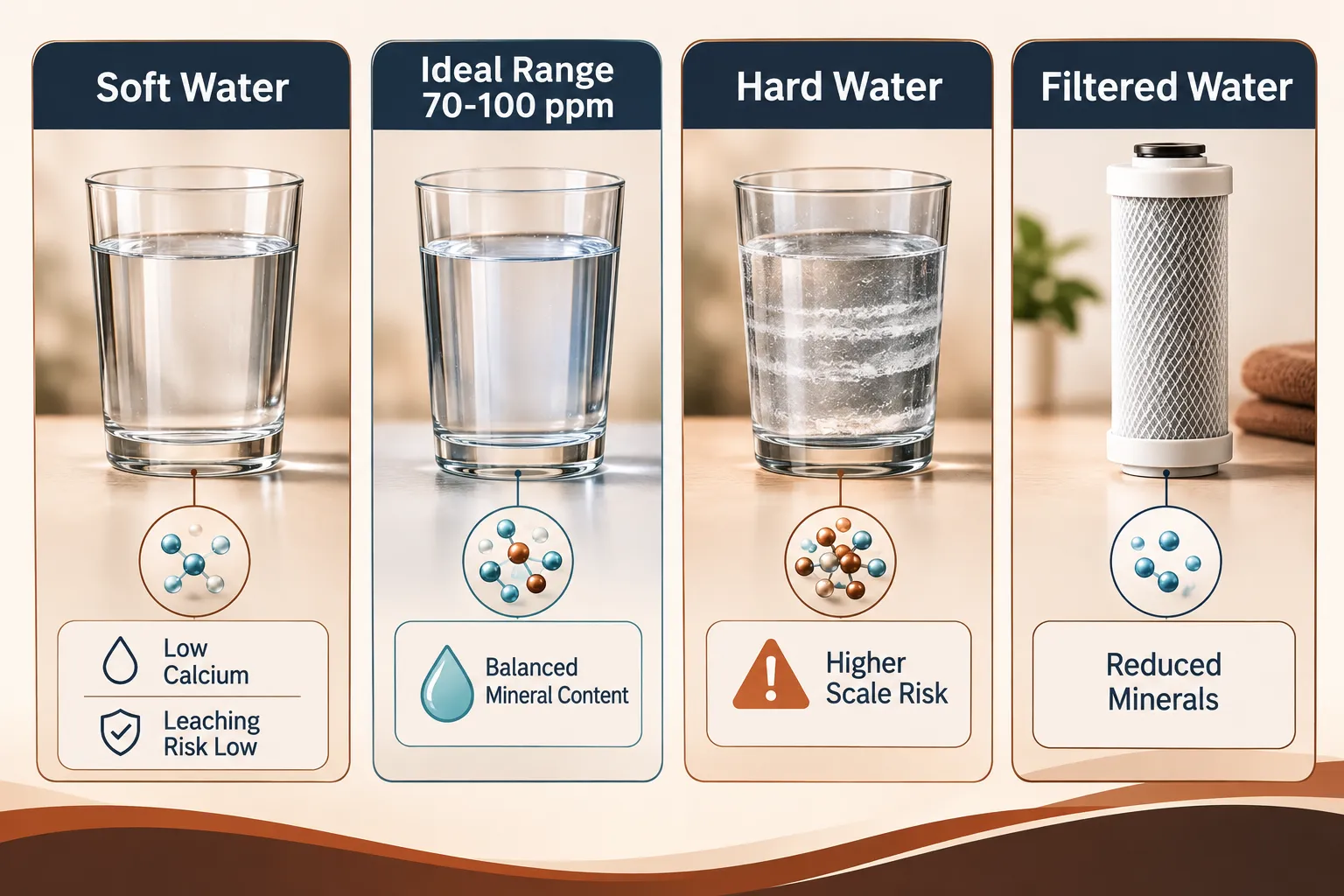
Distilled or extremely low-mineral water can cause two separate issues:
- Leaching, water with almost no dissolved minerals is more chemically aggressive and can pull metal ions out of your boiler and pipes instead of depositing minerals onto them.
- Sensor interference, some machines use water conductivity to detect boiler water levels. Water with too little mineral content doesn’t conduct electricity well, which can confuse these sensors and trigger false low-water warnings or actual sensor failures.
This is part of why manufacturer guidance consistently points toward a target range rather than “as soft as possible.” Zero minerals is its own kind of risk, not a safety margin.
Practical Buying Guidance for Managing Water at Home
You don’t need a water chemistry lab to manage this reasonably well. A few practical steps cover most home situations:
- Test your tap water first. Inexpensive hardness test strips or a water report from your local utility will tell you roughly where you stand before you spend money on filtration.
- Use the filter that came with your machine, if one did. Breville, Gaggia, and similar manufacturers often include a basic filter cartridge designed for their specific machine.
- Consider a dedicated espresso water filter if your tap water tests notably outside the target range for your machine. Pricing on these varies widely, retail listings for replacement cartridges have ranged from around $65 for basic home units up to more than $565 for higher-capacity commercial cartridges, with large commercial hardness-reduction cartridges often landing around $300,$450. A standard home cartridge for a single-group machine will typically sit at the lower end of that range.
- Don’t default to pure bottled or distilled water unless your machine’s documentation specifically supports it.
- Stick to a descaling schedule rather than waiting for symptoms. Our guide on how often you should descale your espresso machine breaks down realistic intervals based on water hardness and usage.
This is a good example of a real-world ownership consideration that’s easy to overlook when comparing machines on price alone. A machine that’s cheap to buy but expensive to descale or repair because of hard water isn’t actually cheap to own.
Common Espresso Problems Linked to Water Quality
When troubleshooting unexplained performance drops, water-related scale is worth ruling in or out early, especially if you haven’t descaled recently. Signs that point toward mineral buildup rather than a grind or dose issue:
- Longer heat-up times than when the machine was new
- Gradually slowing shot times with no change in grind setting
- Inconsistent temperature, especially on machines without a PID controller
- Reduced steam power or weaker milk texturing over time
- Visible white or tan deposits around the water tank, steam wand, or portafilter basket
If you’re also seeing sour or bitter shots alongside these symptoms, it’s worth separating the two issues. Scale affects flow and temperature; alkalinity affects taste directly. Check our broader troubleshooting resources if symptoms point toward extraction rather than equipment wear.
Is a Water Filtration Upgrade Worth It?
Whether a dedicated filtration system is worth the upgrade depends on your water and your machine, not a blanket rule.
Worth it if:
- Your tap water tests above 100-150 ppm hardness
- You own a machine with a published, narrow water specification (common with Lelit, Profitec, and La Marzocco models)
- You’ve already dealt with a scale-related repair or service call
Probably skip it if:
- Your municipal water already tests within or close to the target range
- You’re already using the manufacturer-supplied filter and descaling on schedule
- Your machine has a simple, replaceable heating element with no published strict water spec
This is a case where more filtration isn’t automatically better. Over-filtering toward near-zero mineral content introduces the leaching and sensor risks covered earlier, so the goal is matching your water to the target range, not stripping it as clean as possible.
FAQ
Does hard water ruin espresso flavor? Not as directly as many assume. Recent sensory research found that calcium and magnesium levels alone had little detectable effect on taste. Alkalinity, driven by bicarbonate content, had a much larger effect on acidity, bitterness, and overall cup flatness.
How do I know if my water is too hard for my machine? Check your machine’s manual for a published water specification, then test your tap water with hardness strips or a utility water report. If your hardness sits well above your machine’s stated range, filtration or more frequent descaling is reasonable.
Can I just use bottled spring water instead? Only if you check the label. Many spring waters carry hardness and mineral levels that vary widely by brand and source, and some exceed recommended ranges for espresso machines just as much as hard tap water does.
Is distilled water safe for my espresso machine? Not automatically. Both Breville and La Marzocco specifically warn against water with very little mineral content, since it can cause metal leaching and interfere with water-level sensors in some machines.
How often should I descale if I have hard water? There’s no single number that fits every machine, since it depends on your water’s hardness and how often you use the machine. Our dedicated guide on descaling frequency walks through how to set a realistic schedule.
Does a grinder need protection from hard water too? No, grinders don’t contact brewing water, so hardness doesn’t affect them directly. Water quality is strictly a boiler, pipe, and heating-element concern on the machine side of your setup.
Conclusion
Hard water and espresso machines will always have a slow-motion relationship with each other, but it’s a manageable one. The practical path is straightforward: test your water, match it against your machine’s published spec if one exists, use an appropriate filter if your numbers are notably outside that range, and stay on a consistent descaling schedule rather than waiting for symptoms to show up. None of this requires expensive equipment or obsessive monitoring, it’s a maintenance habit, not a hobby.
If you’re troubleshooting a machine that already feels sluggish, start with our maintenance and water category for descaling steps, or browse our buying guides if you’re choosing a new machine and want to know which models come with built-in water specifications worth paying attention to.
Meta Title: Hard Water and Espresso Machines: Mineral Content Guide
Meta Description: Learn how hard water and espresso machines interact, why mineral content matters for maintenance and taste, and practical steps to protect your equipment.
Tags: hard water espresso, espresso machine maintenance, water hardness, descaling espresso machine, espresso machine scale, water filtration espresso, TDS and alkalinity, espresso troubleshooting, home espresso setup, boiler maintenance, machine and grinder pairing, espresso machine care
Contributing writer at Espresso Savvy.
