

Espresso Accessories You Actually Need vs. Nice-to-Haves
Here’s a number worth sitting with: a Porsche-branded espresso machine with a matching grinder recently launched at a combined price north of 7,000 euros, limited to just over a thousand units worldwide. It comes with branded cups, towels, and canisters. None of it will make the espresso taste better than a well-dialed-in shot from a machine costing a fraction of that price. That’s the real story behind espresso accessories right now, the market is increasingly selling lifestyle and design, while the handful of tools that actually change what’s in your cup stay simple and inexpensive. This guide sorts espresso accessories you actually need vs. nice-to-haves so you can spend money where it matters and skip the rest.
If you’re building a home espresso setup for the first time, or you’ve had a machine for a while and keep seeing shiny new gadgets in your feed, this breakdown will help you separate equipment that changes your results from equipment that just changes your counter aesthetic.
Key Takeaways
- A digital scale is the single most defensible accessory purchase, it turns guesswork into a repeatable process for both dose and yield.
- A properly sized tamper matters for basket fit, but expensive calibrated or spring-loaded versions are optional, not required.
- A WDT tool is a cheap, meaningful fix for clumpy grounds, but it cannot fix a bad grinder.
- Bottomless portafilters are diagnostic, not corrective, they show you channeling, they don’t prevent it.
- Smart, Bluetooth-connected scales and luxury collaboration gear sit firmly in the nice-to-have category for most home users.
Espresso Accessories You Actually Need: The Short List
Before getting into nice-to-haves, it helps to understand what actually changes extraction and consistency. Espresso is, at its core, a ratio-and-time process. The Specialty Coffee Association describes espresso using measurable parameters, dose, yield, brew time, water temperature, and pressure, not vibes or guesswork. That’s exactly why the accessories that matter most are the ones that let you measure those variables accurately.
A Digital Scale
If you only buy one accessory, make it this one. A scale lets you measure grounds going into the portafilter (dose) and liquid espresso coming out (yield), which is the foundation of learning how to dial in your espresso. La Marzocco’s own workflow guidance points to exactly this: scales remove guesswork by making dose and yield repeatable instead of estimated by eye or by filling a cup to a line.
What to look for:
- Resolution of at least 0.1 gram, anything coarser makes small adjustments hard to track
- A responsive timer, built-in or paired with your phone
- A base low-profile enough to fit under your machine’s portafilter on the drip tray
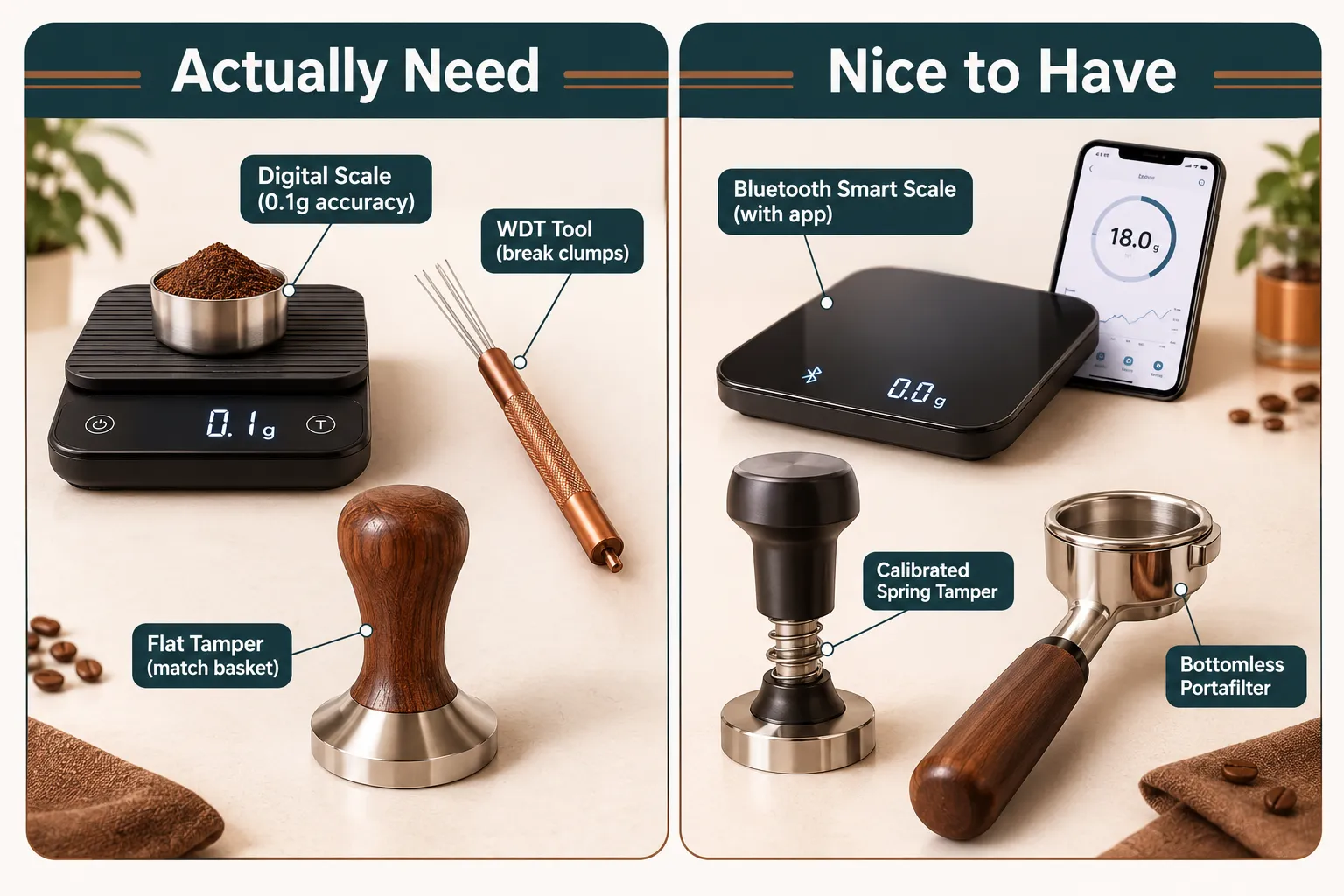
You do not need a connected, app-integrated scale to get this benefit. A basic $20,$40 kitchen-style scale with a stable platform and reasonable resolution does the same core job as far more expensive options. The expensive versions add convenience, not accuracy.
A Tamper That Actually Fits Your Basket
A tamper’s job is simple: create a flat, even, firm puck so water doesn’t carve channels through weak spots. The one non-negotiable spec is diameter. A tamper that’s too small lets grounds build up unevenly around the basket wall; too large and it won’t seat properly. Common sizes include roughly 54 mm for many Breville machines, 58 to 58.5 mm for many prosumer machines like Rancilio Silvia or Profitec models, and 51 mm for some De’Longhi machines.
A flat base matched to your basket size is the need. Calibrated or spring-loaded tampers that click at a set pressure are a nice-to-have, they make tamping force more repeatable from shot to shot, but they don’t fix uneven distribution or a bad grind on their own.
A WDT Tool (When Your Grounds Clump)
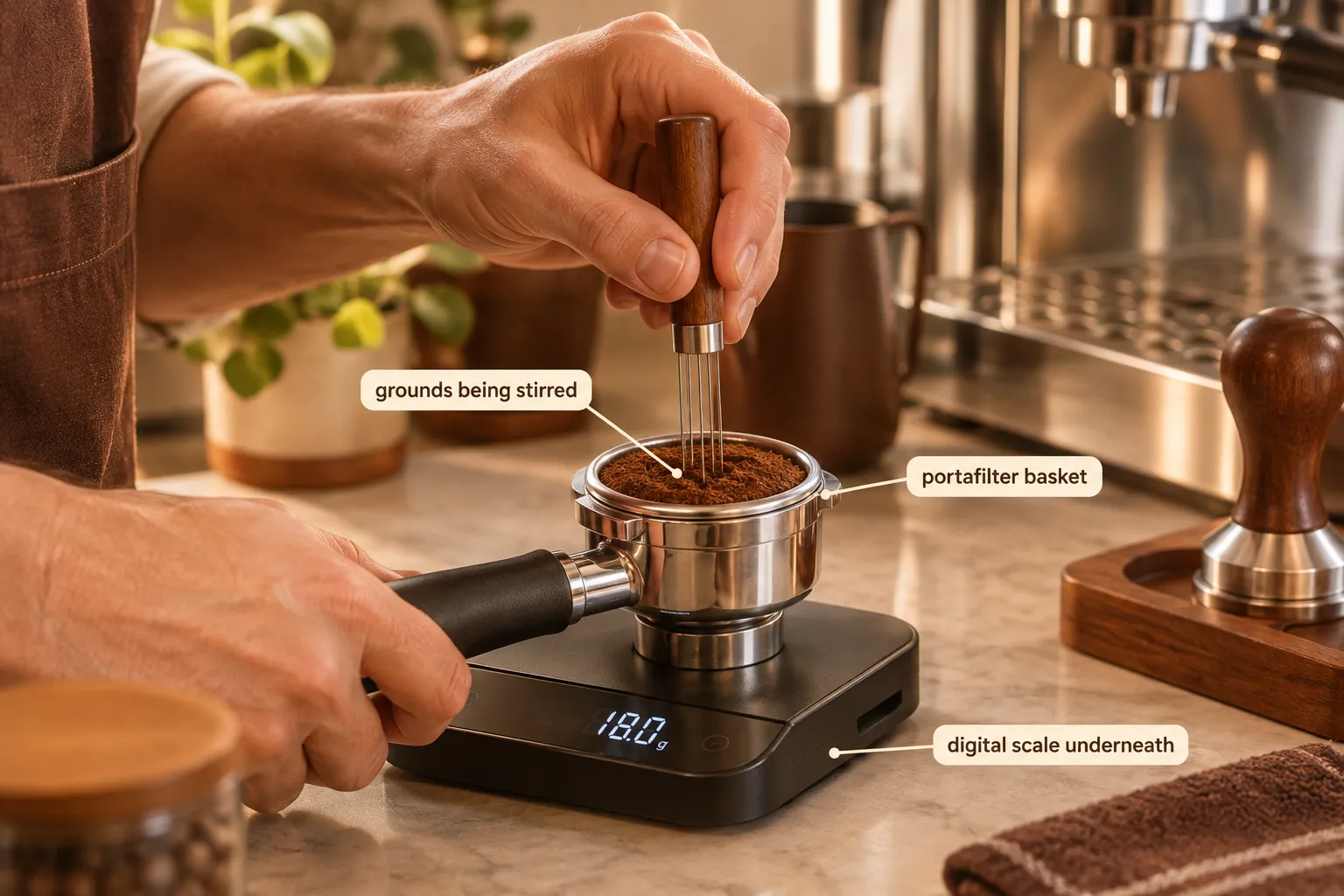
The Weiss Distribution Technique, commonly shortened to WDT, involves stirring grounds with fine needles before tamping to break up clumps and even out density across the puck. Barista Hustle’s analysis on the technique found that stirring thoroughly, down to the bottom of the puck, increases resistance and reduces shot-to-shot variation, a real, measurable improvement for very little money.
This is one of the better examples of practical home espresso spending: a WDT tool typically costs very little and solves a specific, common problem, grounds clumping from static or oily beans. But it’s important to be honest about its limits. WDT distributes already-ground coffee more evenly. It cannot correct a misaligned burr set, excessive fines, wide grind-size variation, or inconsistent dosing. If your shots are inconsistent and your grinder is the weak link, a $15 WDT tool won’t solve that. In that case, your money is better spent on choosing the right grinder or improving your machine and grinder pairing before adding distribution accessories.
Espresso Accessories You Actually Need vs. Nice-to-Haves: The Gray Area
Some accessories genuinely help certain users but aren’t essential for everyone. This is where “who this is for” and “who should skip it” matters most.
Bottomless Portafilters
De’Longhi’s October 2026 launch of the La Specialista Arte Evo alongside a matching bottomless portafilter signals that this accessory has moved from aftermarket enthusiast gear into mainstream manufacturer support. A bottomless portafilter removes the spouts so you can see the espresso stream directly as it exits the basket.
What it’s genuinely good for: spotting channeling, the uneven, fast-flowing streams that signal poor distribution or tamping. It’s a diagnostic tool, not a performance upgrade. It won’t extract espresso any differently than a spouted portafilter, it just shows you problems you’d otherwise only taste.
Who this is for: beginners actively working through espresso troubleshooting and wanting visual feedback while learning technique.
Who should skip it: anyone who finds visible spraying stressful rather than instructive, or anyone whose shots are already consistent. It’s a learning aid, not a requirement for good espresso.
Bluetooth and Smart Scales
Profitec’s current product lineup supports Bluetooth communication between the machine, a compatible scale, and an app, including weight-based automatic shot stopping. Similarly, the BOOKOO Themis Ultra, a premium smart scale listed in late October 2026, combines Bluetooth, a built-in timer, and app connectivity.
These tools are genuinely useful for logging shots over time and automating the stop point of a pour. But the core measurement, weighing coffee in and espresso out, is something a basic non-connected scale does just as accurately. The added value is workflow integration and data tracking, not better shots. If you like tracking your dialing-in process over weeks or want your machine to stop automatically at a target weight, this is worth the upgrade. If you’re comfortable glancing at a scale and stopping the shot yourself, you can skip it without losing anything meaningful in the cup.
When the Better Purchase Is a Grinder, Not an Accessory
This is one of the more important meaningful differences to understand before buying accessories: sometimes the problem you’re trying to solve with a gadget is actually a grinder problem.
Weber Workshops’ October 2026 redesign of its EG-1 grinder kept the same 80 mm flat-burr format but reworked the motor, grinding path, and bean-feeding system, changes aimed at improving consistency at the source. Fellow’s Opus 2, a 48 mm conical-burr grinder launched the same month, was built to handle espresso, filter, and cold brew in one unit, offering an alternative to a narrowly espresso-only grinder.
The practical lesson for home users: a WDT tool can redistribute grounds after grinding, but it can’t fix an inconsistent burr set, limited grind adjustment range, or static-prone chambers. If you’re seeing inconsistent shots, sometimes fast, sometimes slow, with no clear pattern, before buying a fancier tamper or distribution tool, check whether your grinder can actually produce a consistent, fine-enough grind. This is the kind of diagnosis covered in depth in espresso machine maintenance and troubleshooting resources, and it’s often the difference between a shot that’s merely inconsistent and one that’s reliably sour or bitter. If you’re chasing down sourness specifically, start with why your espresso might be sour before assuming an accessory will fix it.
Luxury Collaborations and Lifestyle Accessories
Porsche and La Marzocco’s October 2026 collaboration is a clear example of where the accessory market is heading for some buyers: branded cups, towels, canisters, and a limited-edition Linea Micra and Pico grinder set, priced at €5,790 for the machine and €1,550 for the grinder, with production capped at 911 units across two colorways plus a 150-unit Germany-only version.
There’s nothing wrong with wanting equipment that looks good or feels special to own. But it’s worth being clear-eyed: none of these lifestyle accessories improve extraction, dialing in, or repeatability. They’re design and collectibility purchases, not functional upgrades. If budget is a factor, and for most home users it is, this is squarely in nice-to-have territory, often far beyond nice-to-have and into pure lifestyle spending. For a realistic look at where your money actually goes as a home espresso owner, see the real cost of owning a home espresso machine.
Quick Reference: Need vs. Nice-to-Have
| Accessory | Category | Why |
|---|---|---|
| Digital scale (0.1g) | Need | Makes dose and yield measurable and repeatable |
| Basket-matched flat tamper | Need | Correct diameter prevents uneven pucks |
| WDT tool | Need (if grounds clump) | Low-cost fix for clumping and uneven density |
| Bottomless portafilter | Nice-to-have | Diagnostic visual, not a performance fix |
| Bluetooth smart scale | Nice-to-have | Adds logging and automation, not accuracy |
| Calibrated/spring tamper | Nice-to-have | Repeatable force, doesn't fix distribution |
| Luxury branded sets | Nice-to-have | Design and collectibility, no functional gain |
Real-World Ownership Considerations
A few practical notes for real-world ownership considerations worth keeping in mind:
- Accessories don’t replace fundamentals. Clean equipment, fresh beans, and correct grind size solve more problems than any gadget. Regular upkeep covered in guides on how often to descale your espresso machine matters more day-to-day than most add-ons.
- Buy accessories to solve a specific problem you’re actually having, not because a product launch looks appealing. If your shots are already consistent, a new tool won’t make them more consistent.
- Start cheap. A basic scale and a correctly sized tamper cost a small fraction of a smart scale or calibrated tamper set, and they deliver most of the same practical benefit for a beginner.
- When you’re ready to go deeper into technique and troubleshooting, the dialing in and technique and accessories and setup resources walk through how these tools fit into a full routine.
FAQ
Do I need a scale to make good espresso? You don’t strictly need one to make espresso, but without one you’re guessing at dose and yield, which makes it much harder to repeat a good shot or fix a bad one. It’s the most practical first purchase for anyone learning to dial in espresso.
Is a bottomless portafilter worth buying for a beginner? It’s useful for seeing channeling as you learn, but it won’t improve your espresso on its own. If watching the pour stresses you out more than it teaches you, a standard spouted portafilter works fine.
Should I buy a WDT tool or a better grinder first? If your current grinder produces inconsistent particle sizes or can’t get fine enough, address the grinder first. A WDT tool helps with clumping but can’t fix fundamental grind inconsistency.
Are expensive calibrated tampers better than basic ones? They make tamping force more consistent, which can help some users, but the most important factor is whether the tamper diameter matches your basket. A correctly sized basic tamper outperforms a mismatched expensive one.
Is it worth buying a Bluetooth-connected scale? It depends on whether you want data logging or automatic shot-stopping integration with your machine. The underlying measurement accuracy isn’t meaningfully different from a basic digital scale.
What’s the one accessory that makes the biggest difference for beginners? A digital scale with 0.1 gram resolution. It turns espresso from a guessing game into a measurable, repeatable process, which is the foundation for everything else.
Conclusion
Sorting espresso accessories you actually need vs. nice-to-haves comes down to one question: does this tool change what’s measurable in your cup, or does it just change your counter? A scale, a correctly sized tamper, and a WDT tool for clumpy grounds cover the real needs for most home setups. Bottomless portafilters, smart connected scales, and luxury collaboration gear are reasonable purchases if they fit your budget and workflow, but they’re optional, not foundational.
If you’re just getting started, buy the scale first, confirm your tamper fits your basket, and work through how to dial in espresso before adding anything else. If shots are still inconsistent after that, look at your grinder before reaching for another accessory. Good espresso at home doesn’t require expensive gear, it requires measuring the few things that actually matter and being patient with the process.
Meta Title: Espresso Accessories You Actually Need vs. Nice-to-Haves
Meta Description: Learn which espresso accessories genuinely improve your shots and which are optional extras, with practical buying guidance for home espresso setups.
espresso accessories, home espresso setup, espresso scale, WDT tool, tamper buying guide, bottomless portafilter, dial in espresso, espresso troubleshooting, grinder pairing, home barista, buying guide, practical home espresso
Contributing writer at Espresso Savvy.
